
by Emma Westenberg
The stove is turned on and the biggest pot is found. At Habibi.Works, cooking is a part of the daily routine. The chop, chop, chop and tac, tac, tac sounds are heard from the knives hitting the wooden board, as the tomatoes are diced and onions sliced. So far, nothing is different. In addition to this sizzling beat, songs are playing from a speaker that has gone into the depths of music. From Afghan to Syrian to Sudanese to Somalian to Eritrean hits, the speaker today is playing tunes from Sierra Leone. So far, nothing is different. The cooks in the kitchen are dancing, sometimes even dropping their chopping slicing dicing role all together in the kitchen to show their moves to the others. At the same time, a sharpie pen outlines the following message on a piece of wood: Habibi.Works commemorate the death of Mohamed Lamin from Sierra Leone. This is different.
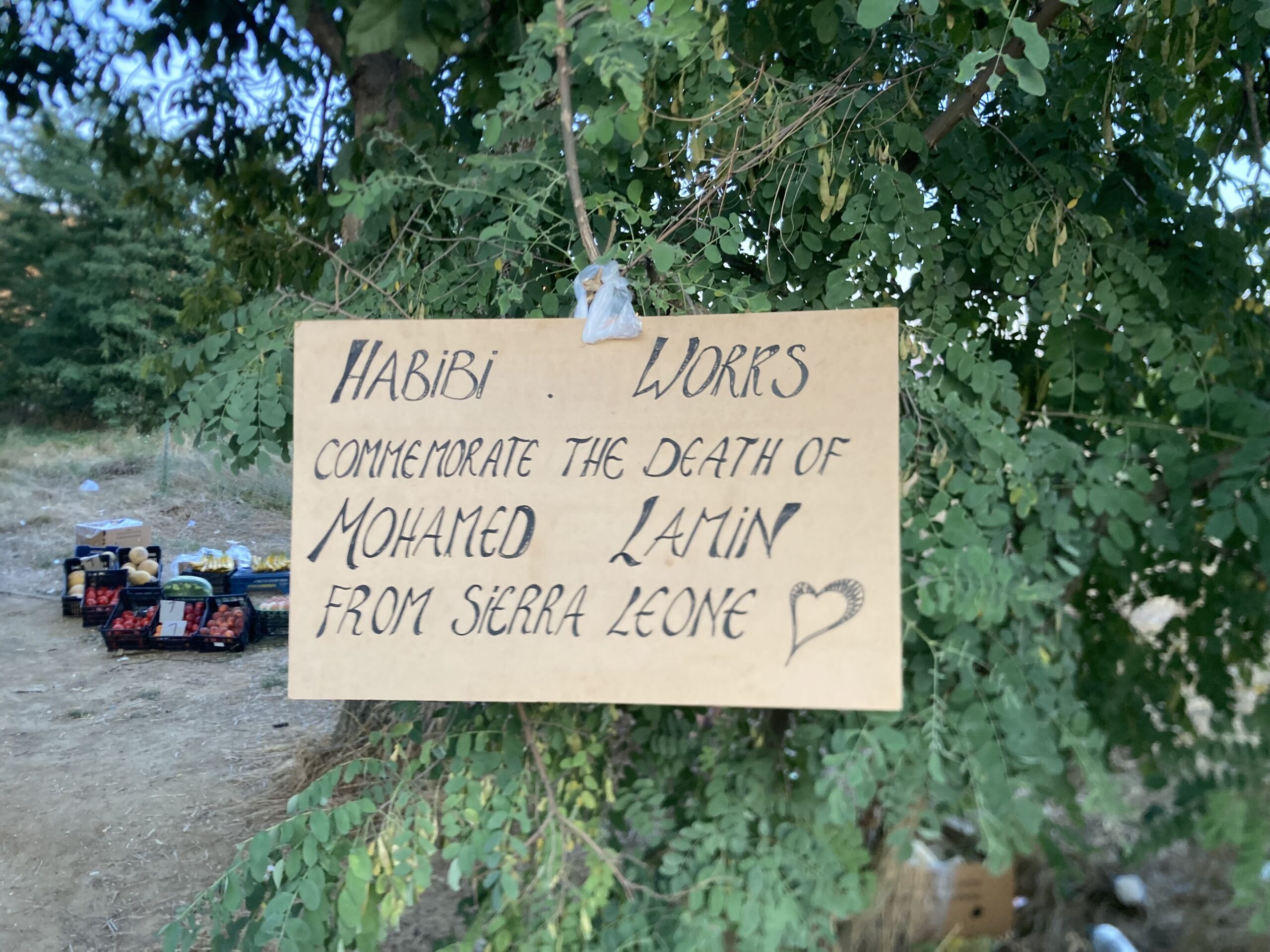
Sign to commemorate the death of Mohamed Lamin, 25 July 2026
Once completed, the food is brought inside the van and then driven to the front of Katsikas camp. The door of the van is opened, plates are brought out, along with coffee, tea, juice and a long enough tarp for everyone to sit on. On Saturday July 25th 2026, over 80 people from camp Katsikas gathered to share a meal together in commemoration of Mohamed Lamin, a person from Sierra Leone, living in Katsikas camp. His death was caused by a drunk driver along the road from the town of Katsikas to the camp while he was biking. This road is known to be dangerous, with the lack of lights and wild dogs, in addition to a driving speed limit of 30km/h that few actually follow. Mohamed, however, was killed by an intoxicated driver. In an instant, a life was taken. As for the said driver, he paid the so-called damages and harm inflicted of 3000 euros, hence avoiding any prison time. Abdula Sesay, resident of Katsikas camp and friend of Mohamed thinks that the unscrupulous driver should be in custody until final judgement, but nothing of such happened, and that the system is inflicted with corrupt politicians. Even so, it is doubtful whether the 3000 EUR actually feel like a consolation of any kind to Mohamed’s family members and friends. The amount, in comparison to a life, feels absurd, ridiculously small.
Beyond these questionable consequences for the drunk driver, the situation begs another question:
Is it not the geographic location of the refugee camp of Katsikas intentionally locating people in remote, isolated, infrastructurely-poor places that put them at risk? The issue has been separated twofold: the camp is far from the main city, and it lacks basic services.
Isolation
To get from the refugee camp outside of Katsikas to the bigger city of Ioannina, the distance is 7 kilometers. To do this route, one of the most common methods of transportation for people living in the camp is the bike, as the bus system is unreliable. Yet, 7 kilometers on two wheels is not an easy undertaking for every person, and this without even speaking about the return.
This geographic isolation strategy is common throughout Greece. There are limited articles on the average distance of Greek camps to villages/cities, but a source found from the International Rescue Committee suggests that the average distance of Closed Controlled Access Centre (CCAC) in Greece to towns is 14kms. In the case of Ioannina, two additional camps surround the city: Agia Eleni, located 3kms from the city, and Filippiada, 53 kms away. Under the blistering sun, barking and aggressive dogs, broken highway-looking roads, with no bike lanes and lack of street lights, in the early morning and late at night, people residing in the Katsikas camp need to travel to request essential services outside of the camp. Women and children walk side-by-side with the hope that the car will see them and the dogs will not. That the motor of the car does not sound too close and that the barking, if any, stays far. That it should be fine. That, anyways, they must travel this road to get basic services.
Lack of basic services
In the camp, the bare minimum is offered, but in restrictive times and quantities. The camp lacks in distributing nutritious food items and does not provide the necessary medical attention that is required by the people forced to live in the camp. For the food, there is a distribution line for lunch, but the food is basic, with little taste and lack of nutrients. As for any medical support, there are doctors in place, but their availability is limited for the amount of individuals in the camp. Hence, residents of the camp must travel to Ioannina for alimentary and health support. To be able to support themselves financially, many people living in Katsikas camp work in chicken factories, in and around Ioannina. For this work too, some hop onto a bike and travel on the road.
Therefore, camps in Greece getting built further away from the main cities, and services remaining inaccessible is nothing new. What is new is the fact that here we are, eating on cushions, placed on the ground, at the entrance of the Katsikas Camp, with the sign “Habibi.Works commemorate the death of Mohamed Lamin from Sierra Leone” perched on a tree found. A Sierra Leonean flag being shared from pairs of hands, moving around. Plates being filled, and then quickly emptied, in between discussions. Here we are, commemorating a life taken too soon, with the negligence of Greek politics contributing to this.
Final statement
At Habibi.Works, we demand a change in the European approach towards camps. Instead of camps existing, we demand that people are offered dignified accommodation while waiting for the decisions in their asylum applications. Camps are not a logistical necessity – they are a political strategy to strip people of their dignity and humanity. Therefore, we call on all member states of the EU to find more dignified accommodation. As for local authorities, the lack of infrastructure surrounding Katsikas camp is a political decision, too. Hence, we call to make more effort in making the road safer and service more accessible, ensuring the safety of people forced to reside in Katsikas camp.